
.webp)
Despite what you've seen in the movies, a dive knife is not for fighting sharks.
It's a safety tool.
Divers have died getting entangled in fishing line, nets, and kelp when a cutting device would have saved them.
Diving near piers in Miami, I've been entangled in fishing line myself. Having a line cutting tool gave me the confidence to get out of there quickly, and stay calm.
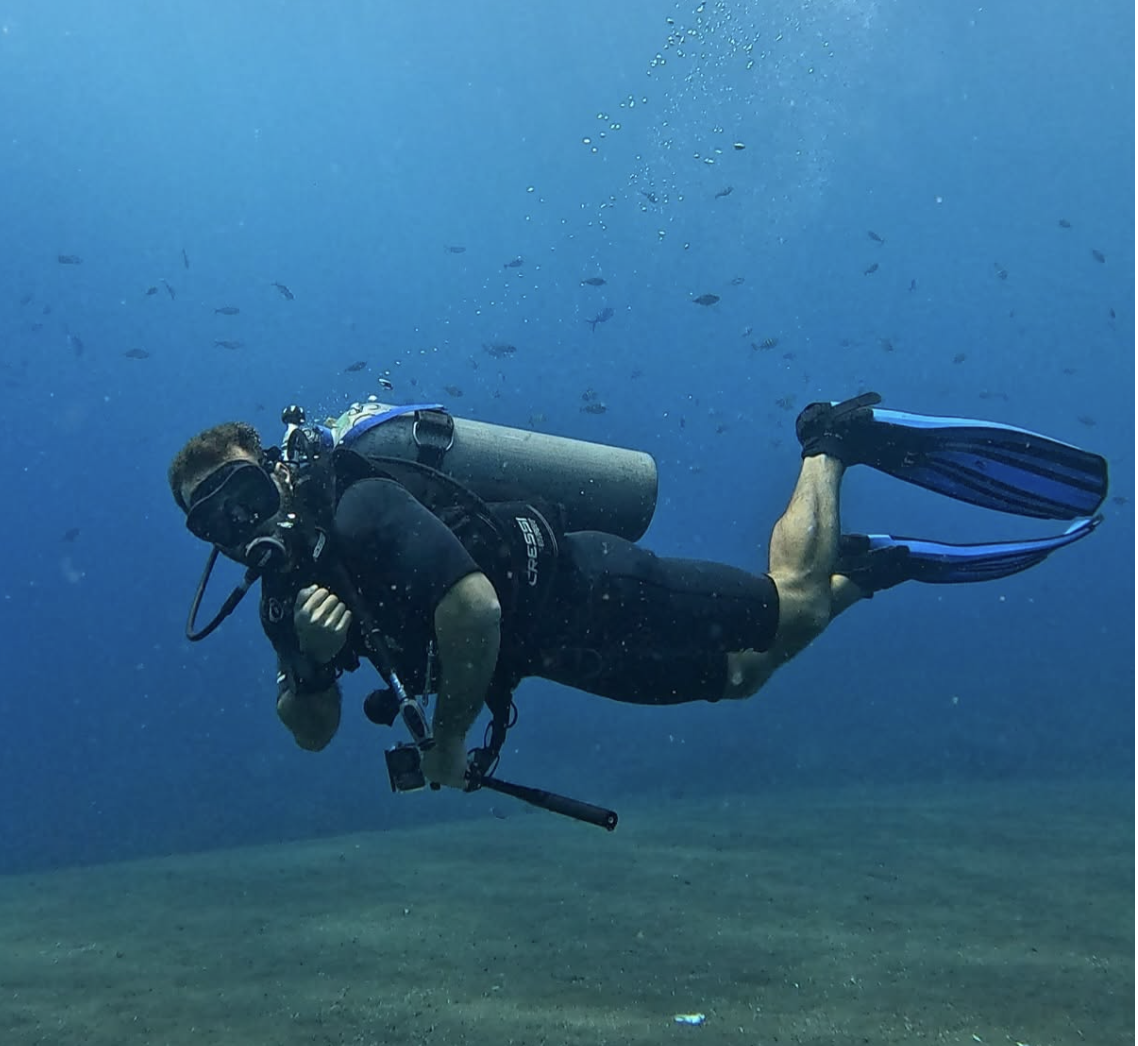
As a PADI Divemaster with five years of diving in Florida, I carry a cutting tool on every single dive.
Here are the four options I recommend, with a buying guide at the end to help you pick the right one.
Best Budget Knife: Cressi Skorpion
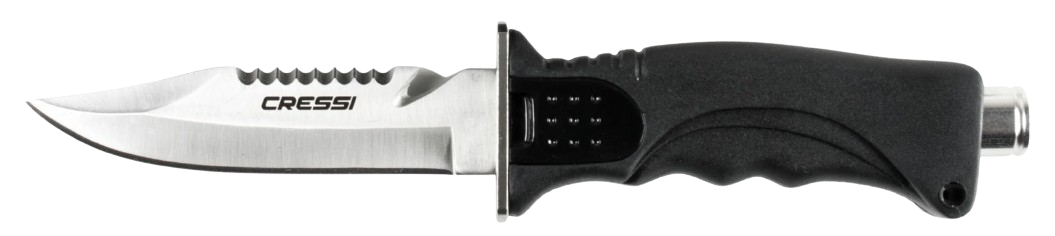
The Cressi Skorpion is the first knife I used and what I'd reccomend to any diver looking for a reliable all-around option without overspending.
The 4.75-inch blade has aserrated, smooth, and line-cutting edge in one tool.
This should cover all entanglement scenarios like fishing line, kelp, nets, and webbing. On the blade, there's a. special coating to help the stainless steel resist saltwater corrosion, but it should still be washed in fresh water after every dive.
The molded rubber handle fits comfortably in most hand sizes and includes a tank-banging tip. The sheath releases with one hand, which matters when you're working quickly underwater.
The rubber straps allow you to attach the blade to an arm or a leg, but I ended up losing mine when it was on a leg mount setup. Perhaps I did something wrong!
Best Premium Knife: SCUBAPRO Mako
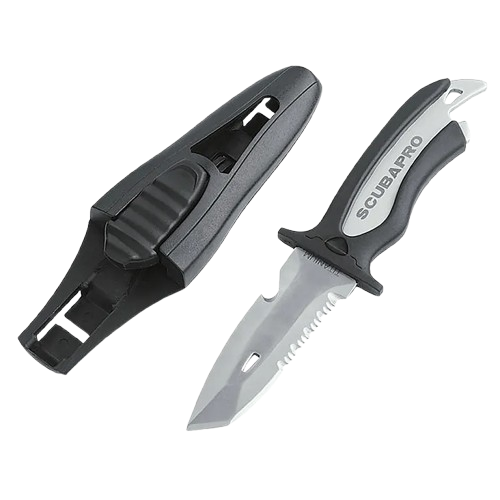
The ScubaPro Mako has a titantium blade which doesn't rust, holds its edge longer than stainless, and weighs almost nothing.
At 3.5 inches (8.9 cm) it sits low against a BCD strap or thigh without getting in the way. It has serrated, smooth, and line-cutting edges in a significantly more compact package than the Skorpion.
The push-button sheath lock is more secure than most clips, and the handle is ambidextrous.
The tip doubles as a tank banger and a bottle opener for post dive fun!
At ~$149 it's the most expensive knife here. Titanium costs more.
It also lasts longer and asks less of you in terms of maintenance, which over the years makes the price gap smaller than it looks.
Best Line Cutter: EEZYCUT Trilobite
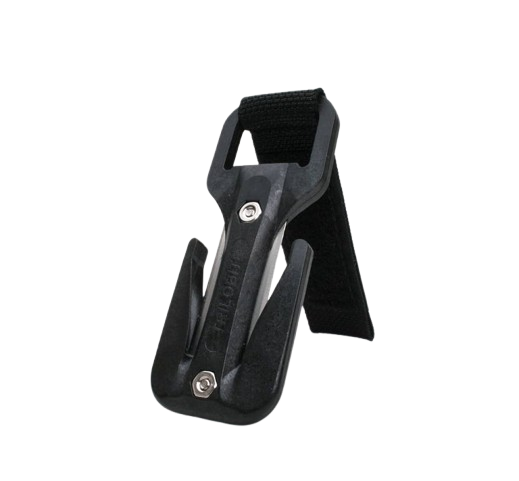
The EEZYCUT Trilobite is the safest cutting tool you can carry, and the one I'd hand to a beginner.
The blade faces backward inside a guarded housing. It's pretty much impossible to accidentally cut yourself, your hoses, or your buddy. You can clip this to your BCD strap unsheathed and forget it's there until you need it.
It cuts through fishing line, nets, and scuba webbing cleanly, and could go through a drysuit if needed. The one limitation is thickness: nothing over 0.47 inches (1.2 cm) would fit. That rules it out for kelp forests where you might need to cut through something more substantial.
It's under $30, travel-friendly, and should be allowed in countries where bringing in a knife is restricted.
Best Shears: Cressi Trauma Shears
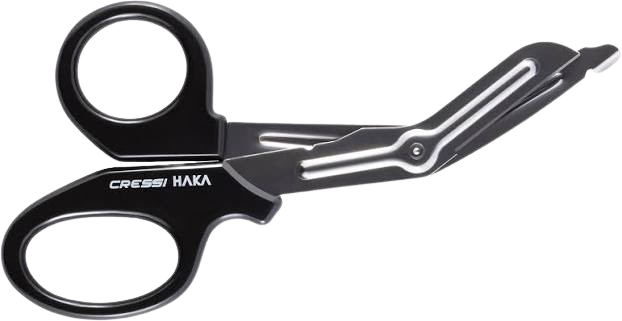
EMTs and firefighters use trauma shears because they cut through almost anything fast. The same logic applies underwater.
These shears handle netting, straps, and drysuits without hesitation. They come in a nylon pouch that threads onto a waistband, strap, or BCD pocket.
The tradeoff is maintenance. Saltwater gets into the scissor mechanism and causes rust faster than with a knife blade.
Rinse thoroughly after every dive, dry completely, and oil the hinge regularly.
Carry these as a backup to your primary knife, not as your only cutting tool. Together they cover every scenario you're likely to face underwater.
Dive Knife Buying Guide
Knife vs Line Cutter vs Shears
Knives are the most versatile. They handle line, kelp, netting, and equipment with a sharp or serrated blade. Best for experienced divers comfortable handling an exposed blade near their gear.
Line cutters have a protected blade that can't accidentally cut hoses or fingers. The most safety-conscious option and the best choice for travel.
Shears cut fast and cut everything, but require more maintenance and are best used as a backup alongside a knife.
Tip: Sharp or Blunt
Sharp tips offer more precision and are preferred by spearfishers and experienced divers. They're also more likely to damage hoses or equipment in an emergency if you're not careful.
Blunt tips are safer around gear, better for prying, and the right call for most recreational divers.
Blade Edge: Serrated or Smooth
Ideally both. A smooth edge cuts through plastic and line cleanly. A serrated edge saws through kelp, rope, and natural materials more effectively.
If you can only have one, serrated is the more useful choice underwater.
Size
Stick to 3 to 5 inches (8 to 13 cm). Bigger knives are harder to control, more likely to snag on gear, and no more effective for what you actually need. A compact knife you can access quickly is more useful than a large one that gets in the way.
Attachment
BCD or hose-mounted is the most secure option and the least likely to be forgotten. Rinse the mount after every dive.
Leg-mounted knives offer quick access but can snag or loosen from the sheath. Check the lock before every dive.
Foldable knives stored in a BCD pocket are the safest carry option for travel and work well with a bungee or clip.
Color
Bright colors make the knife easier to find if you drop it on the seabed and easier for a buddy to grab in an emergency. Visibility is a functional consideration, not an aesthetic one.
Do You Actually Need One?
If you're a beginner diving with an instructor or divemaster, they're already carrying one. You don't need to buy one immediately.
Once you're leading your own dives with a buddy, or diving solo, carry at least one cutting tool, and ideally two: a primary knife and a backup line cutter or shears.
How to Look After Your Knife
Rinse with fresh water after every saltwater dive. Dry completely before returning it to the sheath. Clean the blade and handle with mild soap if there's visible dirt.
Sharpen the blade as needed using a sharpening stone or a standard kitchen sharpener.
For long-term storage, apply a light coat of oil to the blade to prevent moisture from reaching the metal. Dive-specific oils exist for this, but a thin layer of olive or canola oil achieves the same result.
Let's Dive Together
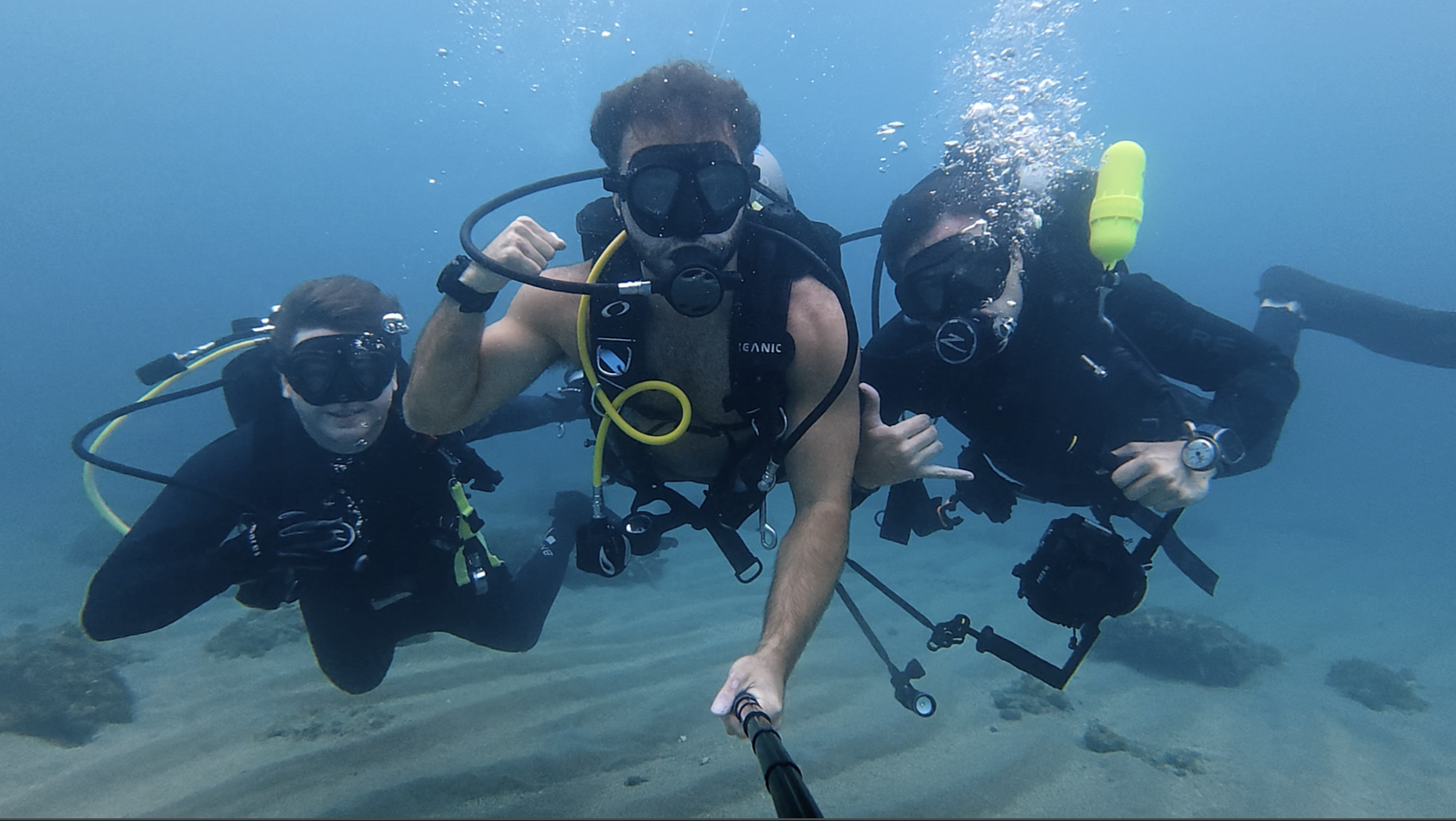
👋 It's Divemaster Austin
I'm inviting you to Dive Club, my global scuba diving community.
What you’ll find inside:
🤿 Dive meetups & group trips
🌍 Top dive sites shared by community members
⚙️ Gear tips & technique discussions
🤝 Diver's who’ve already linked up IRL
See you there!
Join my scuba diving community.
I'm Austin, a PADI Divemaster with over a decade of diving experience under my belt.
I created a free scuba diving community, where divers can connect, learn, and share their dives.
See you inside!
Join my Diving Community

.webp)
.webp)


.png)
.png)